The honest answer to how long a thermal shipping label lasts is that it depends almost entirely on how the label was printed. A standard direct thermal label — the kind that rolls out of most desktop shipping printers with no ink or ribbon — keeps a crisp, scannable image for roughly six months to a year under normal indoor conditions. A thermal transfer label printed with a resin ribbon can stay legible for five to ten years or more. Both look identical the day they come off the printer, which is exactly why so many shippers get caught out later.
For most parcels this difference never matters, because the label only has to survive a few days in transit. It starts to matter the moment a label needs to sit in a warehouse for a season, ride through a hot trailer, come back as a return months later, or satisfy a regulator who expects the marking to still be readable a year on. This guide walks through what actually fades, how long each method realistically holds up, and how to store and specify labels so they last as long as the job needs.
What actually fades on a thermal label
Direct thermal printing has no ink. The label stock is coated with a heat-sensitive layer containing a colorless dye and an acidic developer; the printhead applies heat in the pattern of your barcode and text, the two react, and the image appears. That same chemistry is the weakness. Anything that supplies energy or reactive chemicals to the coating after printing will keep the reaction going — or reverse it — until the image darkens into a gray smear or fades toward blank.
Heat is the fastest enemy. Leave a direct thermal label on a dashboard, near a heat source, or in an un-air-conditioned trailer in summer and the whole coating can turn dark and unreadable within days. Ultraviolet light from direct sunlight or strong indoor lighting bleaches the image over weeks. Moisture and humidity cause smudging and can lift adhesive. Abrasion from labels rubbing against each other or against conveyor rollers physically wears the printed layer away. And plasticizers and solvents — the oily compounds that migrate out of PVC shrink wrap, vinyl, and some cardboard coatings, plus common cleaning chemicals — dissolve the image on contact. Thermal transfer avoids most of this because the image is a solid ribbon material fused onto the surface rather than a reaction baked into the paper.
Realistic lifespans by print method
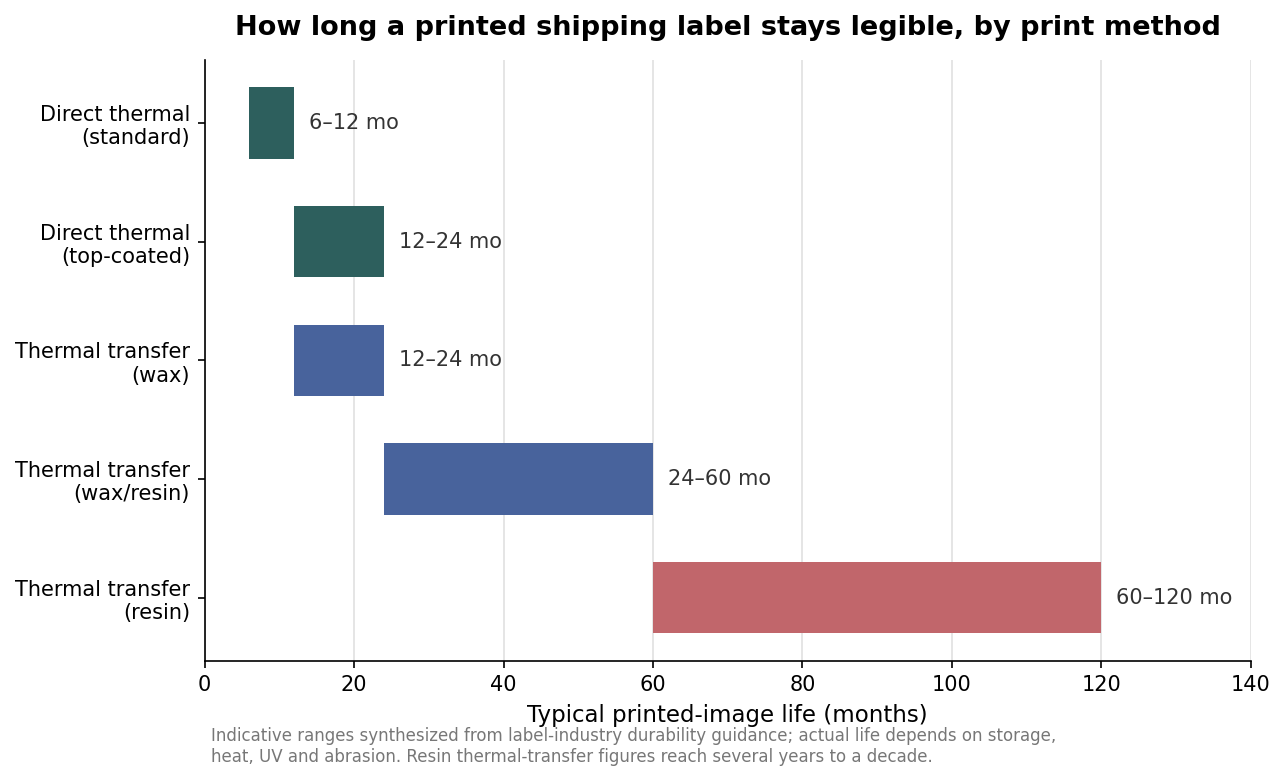
Treat the following as indicative ranges rather than guarantees, because storage and exposure move them substantially. Standard direct thermal holds a scannable image for about six to twelve months. A top-coated direct thermal stock, which adds a protective layer over the reactive coating, pushes that toward one to two years and resists mild moisture and handling far better — a worthwhile upgrade if labels may sit before use or face damp environments.
Thermal transfer spans a much wider range depending on the ribbon. A wax ribbon, the cheapest, behaves a lot like a good direct thermal label in the one-to-two-year band but smears less. A wax-resin blend moves you into the multi-year range with better scratch and smear resistance. A full resin ribbon on a synthetic facestock is the archival option, holding up for five to ten years and shrugging off heat, chemicals, and abrasion that would destroy a direct thermal label in an afternoon. The trade-off is cost and complexity: thermal transfer requires buying and loading ribbons, and resin ribbons on synthetic stock are the most expensive consumable of the group.
Why direct thermal is still the right default for parcels
None of this means direct thermal is a poor choice — for the majority of shipments it is the correct and most economical one. The reason is timing. A shipping label’s real job ends when the parcel is delivered and scanned, and almost every common service completes that trip in a handful of days. Domestic ground and priority services in the United States typically deliver within one to five business days, and even economy international parcels usually clear in two to three weeks. Against a direct thermal image life measured in months, every one of those windows sits comfortably inside the margin.
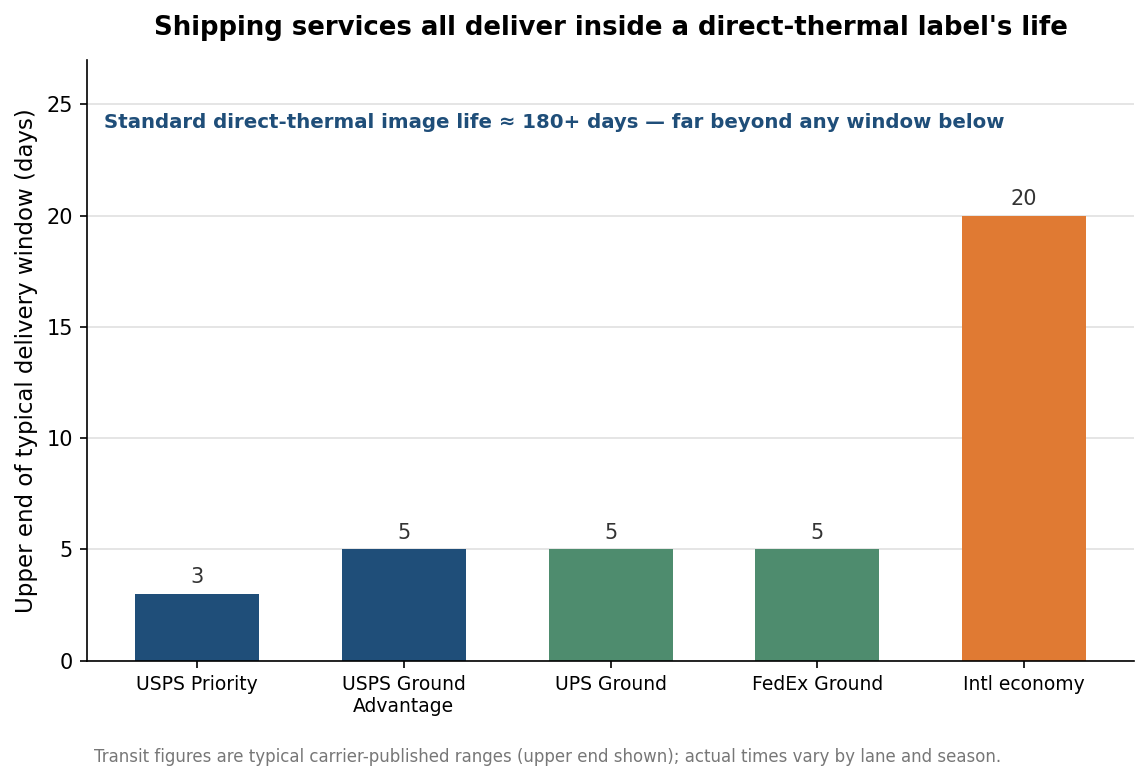
So the practical rule is to match the label to the longest job the label has to survive, not the average one. If your parcels are printed and shipped the same week, standard direct thermal is cheaper, faster, and entirely adequate. You only need to reach for a more durable construction when a label must outlive the delivery: goods stored for months before dispatch, returns labels that may be applied long after they were printed, cold-chain or outdoor exposure, or asset and compliance markings that regulators expect to remain scannable for a year or more.
Storing labels so they reach their rated life
Storage decides whether a label reaches the top or the bottom of its range, and this applies both to unprinted stock and to printed labels waiting to be used. Keep thermal media in a cool, dark, dry place: a controlled room temperature around 18 to 22 degrees Celsius (roughly 65 to 72 Fahrenheit) and relative humidity below about 50 percent is the widely recommended envelope. Unprinted direct thermal rolls generally carry a shelf life of six to twelve months from manufacture, so rotate stock first-in-first-out rather than hoarding a year’s supply.
Beyond temperature and humidity, keep printed labels away from direct sunlight and off surfaces that shed plasticizers — do not store them pressed against PVC binders, vinyl, or freshly printed solvent materials, and avoid adhesive tapes laid directly over a direct thermal image. If labels will face any of those conditions in normal use, that is your signal to specify a top-coated direct thermal or a thermal transfer construction from the start, rather than trying to protect an unsuitable label after the fact.
A quick way to decide
Start by asking how long the printed label must stay scannable, then add a comfortable margin. If the answer is days to a few weeks and the labels are stored indoors, standard direct thermal is the sensible, low-cost default. If the answer is several months, or the labels face heat, sunlight, moisture, or chemical contact, move up to top-coated direct thermal for a modest premium. If the answer is measured in years, or a barcode must survive harsh handling and still scan, specify thermal transfer with a wax-resin or resin ribbon on a synthetic facestock. Buying a decade of durability for a parcel that delivers in three days wastes money; printing a multi-year asset tag on bare direct thermal wastes the whole label. The method, not the brand, is what sets the lifespan.