When a shipping label falls off, the facestock almost never failed; the adhesive did. Industry selection guides are blunt about it: the wrong adhesive is the single most common cause of label failure, and it is also the line item buyers spend the least time specifying. The label looks identical on the roll whether it carries a standard acrylic, a high-tack rubber formula, or a freezer-grade adhesive, so the mistake only shows up weeks later as a carton in a cold warehouse with a curling corner where the barcode used to be. This guide covers the adhesive families that matter for shipping and barcode labels, the two temperature numbers on every datasheet, and the surface-energy problem behind labels that will not stick to poly mailers and recycled cardboard.
The four families that cover almost every shipping job
Standard permanent acrylic is the default on stock shipping labels: clean, stable, resistant to yellowing, and happy on paper, glass, metal, and smooth higher-energy plastics in ambient conditions. Removable acrylic trades holding power for clean release; it belongs on returnable totes, glass, and retail surfaces where residue is unacceptable, not on outbound cartons. High-tack and rubber-based permanents exist for the surfaces standard acrylic cannot grip: polyethylene and polypropylene film, textured or dusty board, and cold, damp, or slightly oily conditions. Rubber hot-melt formulas grab hardest and fastest, with the published trade-off that they age and yellow under UV faster than acrylics, which rarely matters inside a shipping lane. Cold-temperature and freezer-grade acrylics are chemistry tuned to stay flexible below the point where standard formulas stiffen; selection guides note that a standard adhesive may function at freezing yet effectively crystallize by minus 20 Celsius, which is exactly the range a frozen-goods label lives in.
The two numbers that matter: application and service temperature
Every adhesive datasheet carries two temperatures buyers routinely confuse. The minimum application temperature is the coldest the label and surface can be at the moment of sticking; below it, the adhesive cannot flow into the surface and never forms a full bond. The service range is what the bond tolerates after it has set. Published figures for a standard permanent acrylic run around a 40°F application minimum with a service range of roughly 35°F to 200°F. Cold-temperature acrylics push application down to about 25°F and service to 20°F. Freezer-grade formulas apply at 0°F and hold to published floors around minus 65°F. The order of operations is the trap: a label applied warm and then frozen usually survives, while the same label applied to an already-cold carton fails immediately, because it never bonded in the first place. If cartons are labeled inside a chilled dock, spec by the dock temperature, not the warehouse the truck departs from.
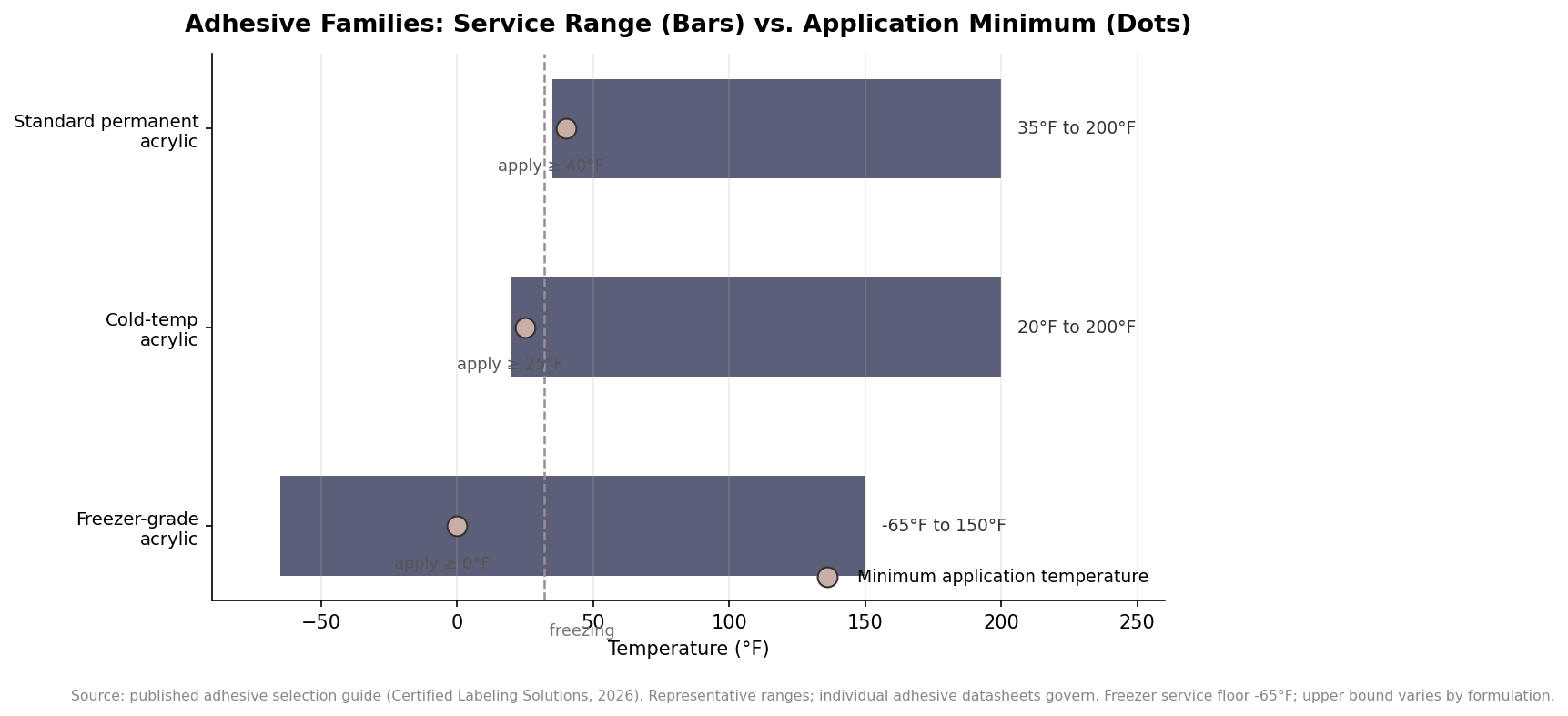
Condensation is the second cold-chain antagonist. When a cold carton meets warm air, moisture films over the surface immediately and physically blocks adhesive contact. No adhesive bonds through standing water, so the fix is procedural as much as chemical: label before chilling where possible, or wipe and label fast, and favor high-tack formulas that wet out quickly.
Surface energy: why the poly mailer wins
Adhesion is physics before it is chemistry. An adhesive bonds by flowing across a surface, and how well it spreads depends on the surface’s energy, measured in dyne per centimeter. Published reference charts put glass at 60 to 72 dyne and steel at 42 to 55, which is why almost anything sticks to them. Untreated polyethylene sits at 30 to 33 and polypropylene at 29 to 31, low enough that a standard acrylic beads up instead of wetting out, and PTFE, the stuff of release liners, sits at 18 to 20, which is precisely why your labels peel off their backing so easily. The practical threshold most converters use is around 36 dyne: above it, standard permanents perform; below it, you need a high-tack or rubber-based formula designed for low-energy surfaces.
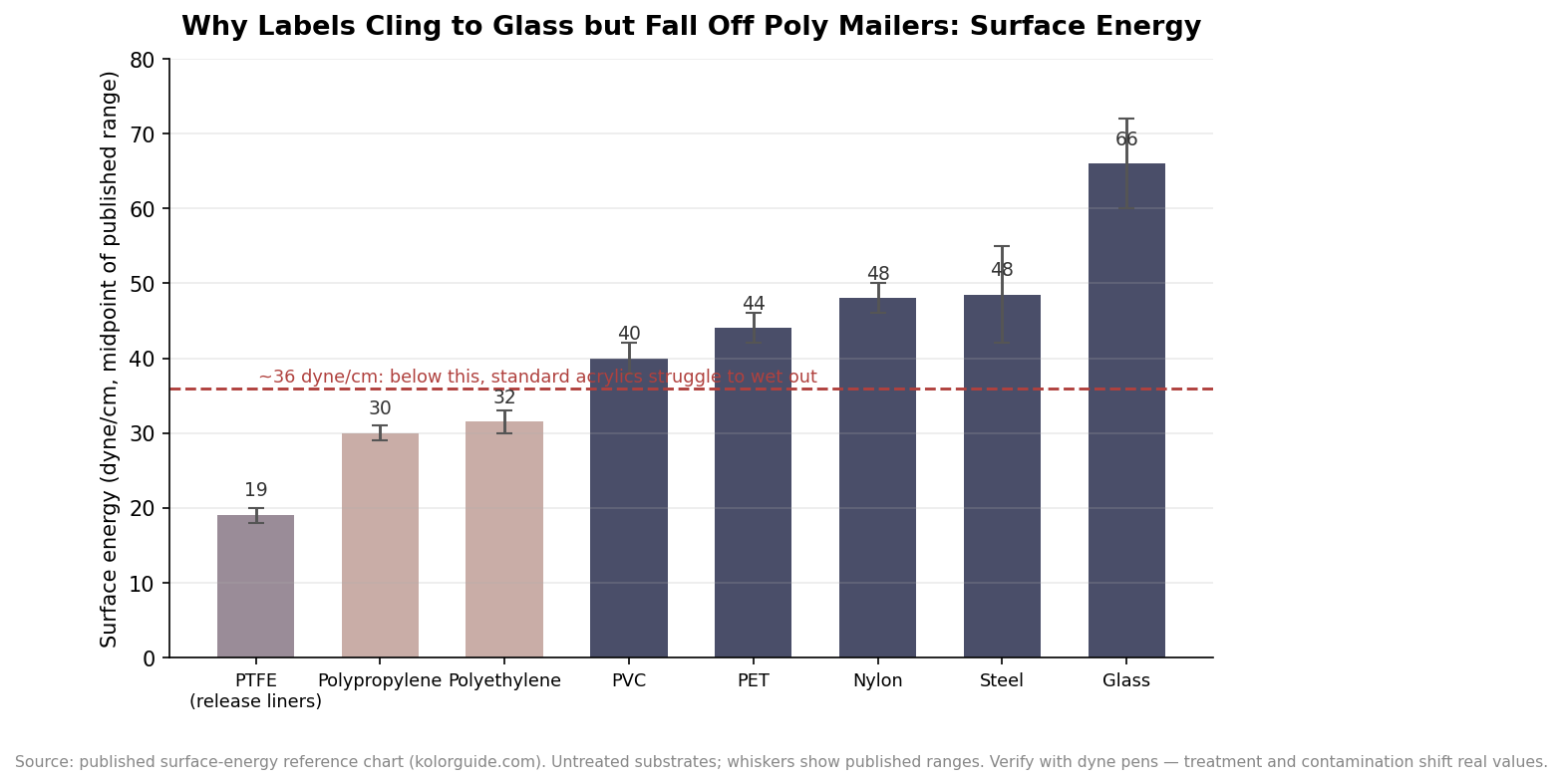
This is the whole story behind labels that fall off poly mailers and polyethylene bags: the surface is low-energy, and the cure is specifying an adhesive rated for PE and PP rather than blaming the printer. Recycled corrugated fails for a related reason; the surface energy is adequate, but the loose recycled fibers and dust shear away under the label, taking the bond with them. High-initial-tack formulas that grab the fiber layer fast are the standard answer, and the published guidance to verify with a dyne pen before a big run is cheap insurance, since surface treatments and contamination shift real-world values well away from the reference chart.
Writing the adhesive line on your label spec
A complete adhesive spec is four short statements. Name the surface exactly, including whether the corrugated is virgin or recycled and whether mailers are PE film. State the coldest application temperature in your process, measured at the surface, not the room. State the full service range the shipment will see, from freezer to a summer trailer, where published ranges for standard acrylics top out around 200°F. And state removability: permanent for outbound shipping labels, removable only where residue-free release is a requirement. Give those four lines to your converter and let them name the adhesive; they carry a dozen formulations and will match one to the spec. Order a sample roll and test it on your actual cartons through your actual process, including a night in the freezer if that is where the product lives, because the datasheet describes laboratory steel and glass panels, and your dusty recycled double-wall is neither. A one-week adhesion test costs almost nothing; relabeling a pallet of frozen inventory, or losing a shipment because the barcode landed on the warehouse floor, does.